
The Hidden Cost of Concentration
The Hidden Cost of Concentration
Elliot Rowan
Partner & Chief Investment Officer
Elliot Rowan
Partner & Chief Investment Officer
This white paper presents Cairnwood’s perspective on concentration risk and how real estate families can preserve conviction while building greater financial resilience.
This white paper presents Cairnwood’s perspective on concentration risk and how real estate families can preserve conviction while building greater financial resilience.
Illustrative thought leadership for a fictional advisory brand. For educational and portfolio demonstration purposes only; not individualized investment, tax, legal, or accounting advice.
Illustrative thought leadership for a fictional advisory brand. For educational and portfolio demonstration purposes only; not individualized investment, tax, legal, or accounting advice.
WHITE PAPER
WHITE PAPER
The Hidden Cost of Concentration
The Hidden Cost of Concentration
The Hidden Cost of Concentration
Real estate can create extraordinary wealth, but it can also concentrate risk in ways that are easy to overlook. This paper explores how families can evaluate liquidity, leverage, geographic and property exposure, and portfolio diversification without abandoning the assets, expertise, and conviction that created their success.
Real estate can create extraordinary wealth, but it can also concentrate risk in ways that are easy to overlook. This paper explores how families can evaluate liquidity, leverage, geographic and property exposure, and portfolio diversification without abandoning the assets, expertise, and conviction that created their success.
info@cairnwoodwealth.com
info@cairnwoodwealth.com
The Hidden Cost of Concentration
The Hidden Cost of Concentration
September 2026
Concentration is not the enemy. Unexamined concentration is.
Concentration is not the enemy. Unexamined concentration is.
Many successful real-estate families became wealthy because they were willing to concentrate capital, expertise and attention in a small number of markets, property types or operating platforms. That concentration can be a source of edge. It can also become a source of fragility when the rest of the family balance sheet quietly depends on the same economic drivers.
The central question is not whether a family should simply diversify away from what it knows. It is whether the family understands where its exposures overlap, how much liquidity exists outside the operating portfolio, what leverage can demand in a difficult market, and how ownership structures will behave through a transition.
Many successful real-estate families became wealthy because they were willing to concentrate capital, expertise and attention in a small number of markets, property types or operating platforms. That concentration can be a source of edge. It can also become a source of fragility when the rest of the family balance sheet quietly depends on the same economic drivers.
The central question is not whether a family should simply diversify away from what it knows. It is whether the family understands where its exposures overlap, how much liquidity exists outside the operating portfolio, what leverage can demand in a difficult market, and how ownership structures will behave through a transition.
The Premise
The objective is to make the rest of the balance sheet more resilient around the assets the family intends to keep.
The objective is to make the rest of the balance sheet more resilient around the assets the family intends to keep.
See the overlap
Property, business, debt and personal wealth can all depend on the same cycle.
See the overlap
Property, business, debt and personal wealth can all depend on the same cycle.
Design liquidity
Design liquidity
Available capital matters most before a refinancing, tax bill or opportunity creates urgency.
Available capital matters most before a refinancing, tax bill or opportunity creates urgency.
Diversify around conviction
A liquid portfolio can complement concentrated real-estate wealth without forcing a sale of strategic assets.
Diversify around conviction
A liquid portfolio can complement concentrated real-estate wealth without forcing a sale of strategic assets.
info@cairnwoodwealth.com
info@cairnwoodwealth.com
The Hidden Cost of Concentration
The Hidden Cost of Concentration
September 2026
Concentration often created the advantage.
Concentration often created the advantage.
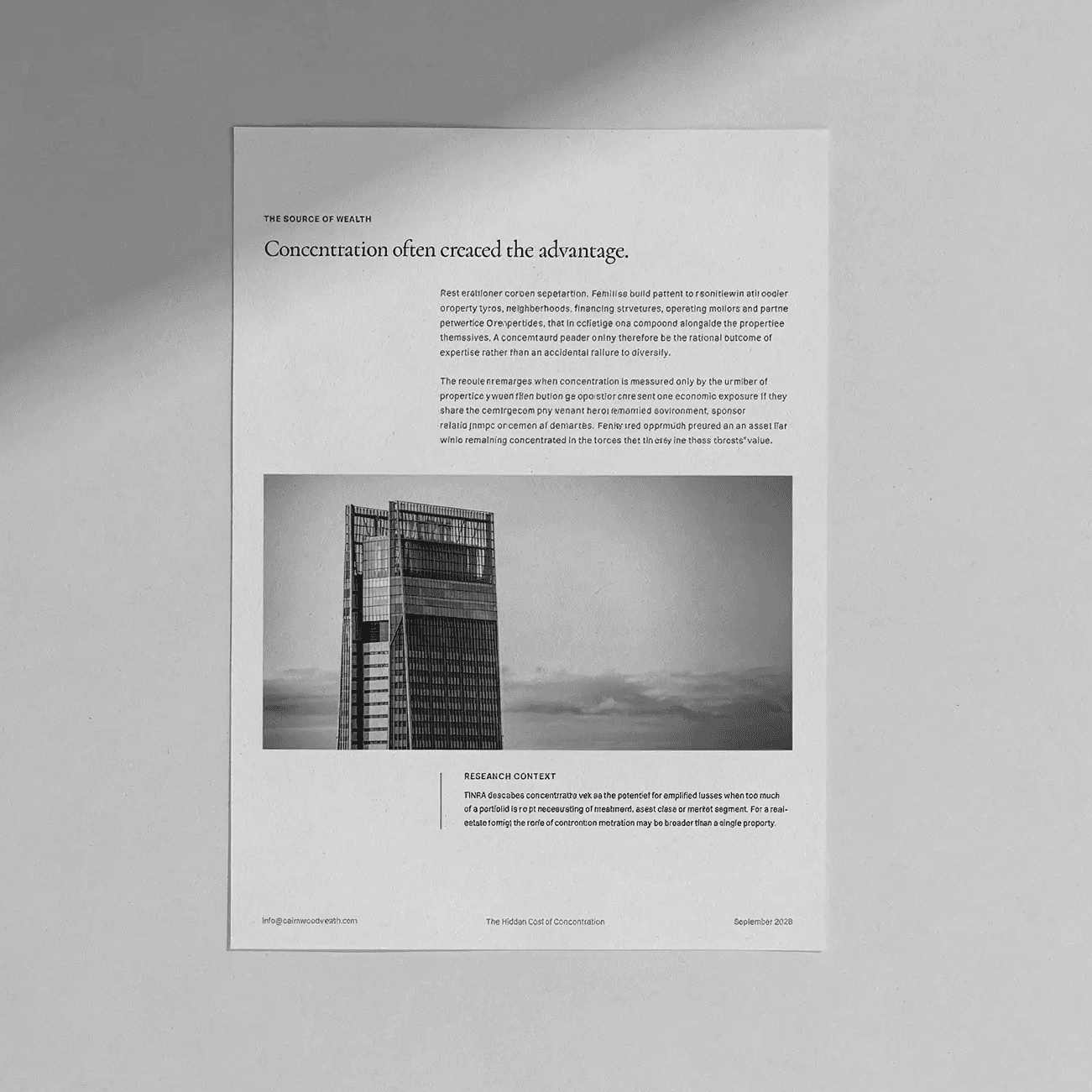
Real estate rewards specialization. Families build pattern recognition in particular property types, neighborhoods, financing structures, operating models and partner networks. Over decades, that knowledge can compound alongside the properties themselves. A concentrated portfolio may therefore be the rational outcome of expertise rather than an accidental failure to diversify.
The problem emerges when concentration is measured only by the number of properties owned. Ten buildings can still represent one economic exposure if they share the same geography, tenant base, financing environment, sponsor relationships or source of demand. A family can appear diversified on an asset list while remaining concentrated in the forces that determine those assets' value.
Real estate rewards specialization. Families build pattern recognition in particular property types, neighborhoods, financing structures, operating models and partner networks. Over decades, that knowledge can compound alongside the properties themselves. A concentrated portfolio may therefore be the rational outcome of expertise rather than an accidental failure to diversify.
The problem emerges when concentration is measured only by the number of properties owned. Ten buildings can still represent one economic exposure if they share the same geography, tenant base, financing environment, sponsor relationships or source of demand. A family can appear diversified on an asset list while remaining concentrated in the forces that determine those assets' value.
Real estate rewards specialization. Families build pattern recognition in particular property types, neighborhoods, financing structures, operating models and partner networks. Over decades, that knowledge can compound alongside the properties themselves. A concentrated portfolio may therefore be the rational outcome of expertise rather than an accidental failure to diversify.
The problem emerges when concentration is measured only by the number of properties owned. Ten buildings can still represent one economic exposure if they share the same geography, tenant base, financing environment, sponsor relationships or source of demand. A family can appear diversified on an asset list while remaining concentrated in the forces that determine those assets' value.

Research Context
Research Context
FINRA describes concentration risk as the potential for amplified losses when too much of a portfolio is exposed to a single investment, asset class or market segment. For a real-estate family, the relevant unit of concentration may be broader than a single property.
info@cairnwoodwealth.com
info@cairnwoodwealth.com
The Hidden Cost of Concentration
The Hidden Cost of Concentration
September 2026
Five forms of concentration that matter.
Five forms of concentration that matter.
Five forms of concentration that matter.
Property and geography
Property and geography
Owning multiple assets does not automatically create diversification. Properties can share the same local economy, interest-rate sensitivity, insurance environment, tenant profile, development cycle or regulatory exposure. Families should look past the property count and ask what common factors actually drive cash flow and value.
Owning multiple assets does not automatically create diversification. Properties can share the same local economy, interest-rate sensitivity, insurance environment, tenant profile, development cycle or regulatory exposure. Families should look past the property count and ask what common factors actually drive cash flow and value.
Owning multiple assets does not automatically create diversification. Properties can share the same local economy, interest-rate sensitivity, insurance environment, tenant profile, development cycle or regulatory exposure. Families should look past the property count and ask what common factors actually drive cash flow and value.
Leverage and refinancing
Leverage and refinancing
Debt can expand returns and preserve capital for new opportunities, but it can also synchronize risk across otherwise separate assets. Maturities clustered in the same period, floating-rate exposure, recourse provisions or cross-collateralization can turn a market slowdown into a balance-sheet event. Refinancing capacity deserves to be viewed at the family level, not only property by property.
Debt can expand returns and preserve capital for new opportunities, but it can also synchronize risk across otherwise separate assets. Maturities clustered in the same period, floating-rate exposure, recourse provisions or cross-collateralization can turn a market slowdown into a balance-sheet event. Refinancing capacity deserves to be viewed at the family level, not only property by property.
Debt can expand returns and preserve capital for new opportunities, but it can also synchronize risk across otherwise separate assets. Maturities clustered in the same period, floating-rate exposure, recourse provisions or cross-collateralization can turn a market slowdown into a balance-sheet event. Refinancing capacity deserves to be viewed at the family level, not only property by property.
Operating and business exposure
Operating and business exposure
Developers and operators often hold personal wealth, carried interests, management-company economics and direct property stakes that all depend on the same transaction cycle. A downturn can reduce property values, transaction income and business cash flow at once. The family's 'human capital' may be concentrated in the same industry as its financial capital.
Developers and operators often hold personal wealth, carried interests, management-company economics and direct property stakes that all depend on the same transaction cycle. A downturn can reduce property values, transaction income and business cash flow at once. The family's 'human capital' may be concentrated in the same industry as its financial capital.
Developers and operators often hold personal wealth, carried interests, management-company economics and direct property stakes that all depend on the same transaction cycle. A downturn can reduce property values, transaction income and business cash flow at once. The family's 'human capital' may be concentrated in the same industry as its financial capital.
Liquidity and timing
Liquidity and timing
Net worth and available capital are different things. A family can be exceptionally wealthy and still face a liquidity constraint when tax payments, capital calls, debt maturities, distributions or new acquisitions arrive together. Liquidity becomes most expensive when it must be created under pressure.
Net worth and available capital are different things. A family can be exceptionally wealthy and still face a liquidity constraint when tax payments, capital calls, debt maturities, distributions or new acquisitions arrive together. Liquidity becomes most expensive when it must be created under pressure.
Net worth and available capital are different things. A family can be exceptionally wealthy and still face a liquidity constraint when tax payments, capital calls, debt maturities, distributions or new acquisitions arrive together. Liquidity becomes most expensive when it must be created under pressure.
Ownership and succession
Ownership and succession
Concentration becomes more complicated when one generation wants to continue operating while another wants distributions, diversification or a different level of risk. The same property portfolio can represent a business to one heir, an inheritance to another and an income source to a third. Ownership structure and governance determine whether those differences can be managed deliberately.
Concentration becomes more complicated when one generation wants to continue operating while another wants distributions, diversification or a different level of risk. The same property portfolio can represent a business to one heir, an inheritance to another and an income source to a third. Ownership structure and governance determine whether those differences can be managed deliberately.
Concentration becomes more complicated when one generation wants to continue operating while another wants distributions, diversification or a different level of risk. The same property portfolio can represent a business to one heir, an inheritance to another and an income source to a third. Ownership structure and governance determine whether those differences can be managed deliberately.
info@cairnwoodwealth.com
info@cairnwoodwealth.com
The Hidden Cost of Concentration
The Hidden Cost of Concentration
September 2026
Risk rarely stays inside one account.
Risk rarely stays inside one account.
Risk rarely stays inside one account.
A conventional investment portfolio can be measured independently. A family enterprise cannot. Property values influence borrowing capacity. Borrowing affects distributions and acquisition flexibility. Tax obligations affect liquidity. Trusts and entities affect who controls assets and who receives cash. Personal portfolios may either offset or compound the risks already present in the operating business.
A conventional investment portfolio can be measured independently. A family enterprise cannot. Property values influence borrowing capacity. Borrowing affects distributions and acquisition flexibility. Tax obligations affect liquidity. Trusts and entities affect who controls assets and who receives cash. Personal portfolios may either offset or compound the risks already present in the operating business.
A conventional investment portfolio can be measured independently. A family enterprise cannot. Property values influence borrowing capacity. Borrowing affects distributions and acquisition flexibility. Tax obligations affect liquidity. Trusts and entities affect who controls assets and who receives cash. Personal portfolios may either offset or compound the risks already present in the operating business.
This is why concentration should be evaluated as a system of relationships rather than a list of assets. The most useful question is often not, 'How much real estate do we own?' but, 'What events would affect several parts of our financial life at the same time?
This is why concentration should be evaluated as a system of relationships rather than a list of assets. The most useful question is often not, 'How much real estate do we own?' but, 'What events would affect several parts of our financial life at the same time?
This is why concentration should be evaluated as a system of relationships rather than a list of assets. The most useful question is often not, 'How much real estate do we own?' but, 'What events would affect several parts of our financial life at the same time?
Exposure
Exposure
What to examine
What to examine
Property concentration
Property concentration
Geography, type, tenants, duration
Debt
Debt
Maturities, rates, collateral, recourse
Operating business
Operating business
Fee income, payroll, pipeline, guarantees
Liquid portfolio
Liquid portfolio
Sector, duration, credit, liquidity
Ownership structures
Ownership structures
Trusts, entities, voting rights, distributions
info@cairnwoodwealth.com
info@cairnwoodwealth.com
The Hidden Cost of Concentration
The Hidden Cost of Concentration
September 2026
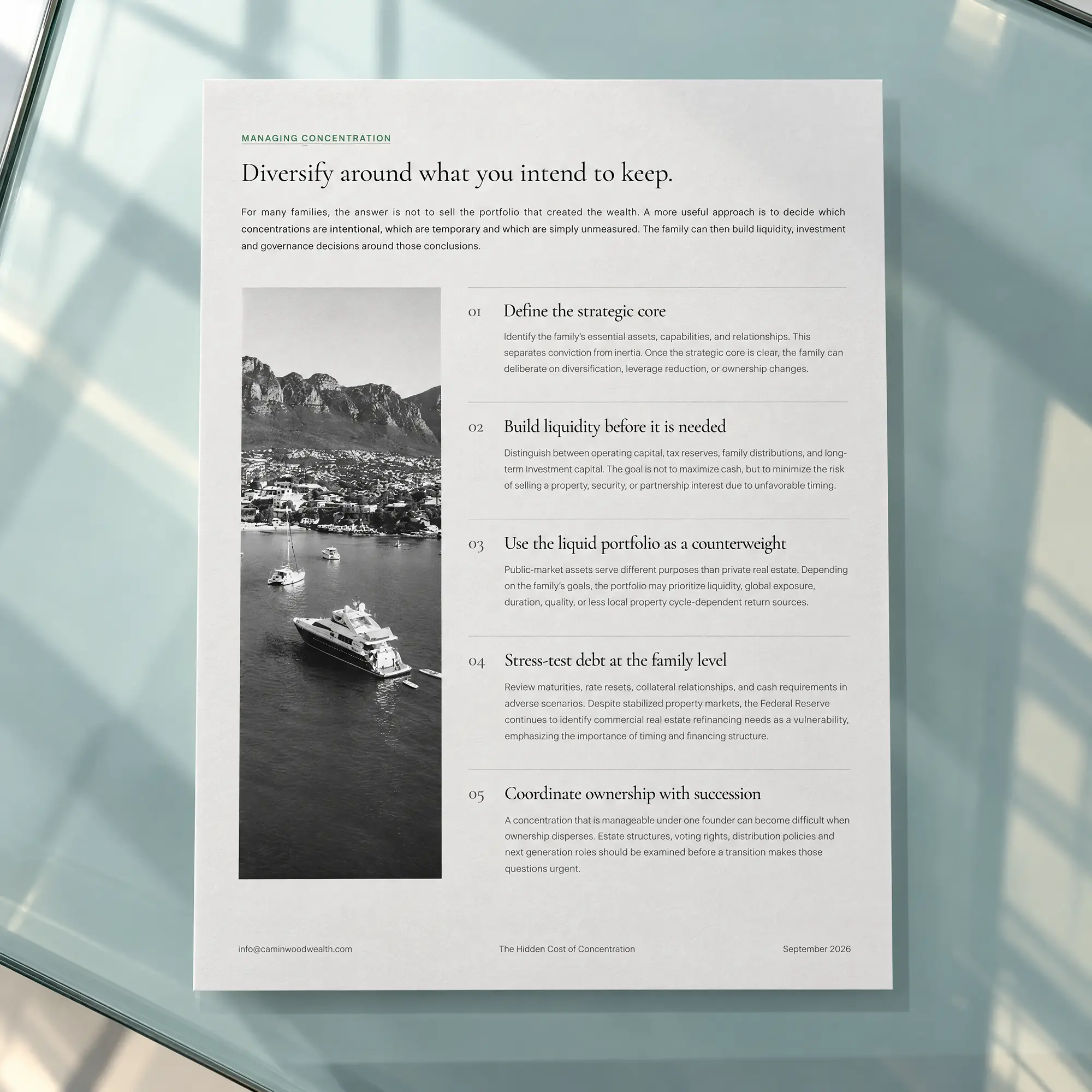
Diversify around what you intend to keep.
Diversify around what you intend to keep.
Diversify around what you intend to keep.
For many families, the answer is not to sell the portfolio that created the wealth. A more useful approach is to decide which concentrations are intentional, which are temporary and which are simply unmeasured. The family can then build liquidity, investment and governance decisions around those conclusions.
For many families, the answer is not to sell the portfolio that created the wealth. A more useful approach is to decide which concentrations are intentional, which are temporary and which are simply unmeasured. The family can then build liquidity, investment and governance decisions around those conclusions.
For many families, the answer is not to sell the portfolio that created the wealth. A more useful approach is to decide which concentrations are intentional, which are temporary and which are simply unmeasured. The family can then build liquidity, investment and governance decisions around those conclusions.

01
01
Define the strategic core
Define the strategic core
Define the strategic core
Identify the family’s essential assets, capabilities, and relationships. This separates conviction from inertia. Once the strategic core is clear, the family can deliberate on diversification, leverage reduction, or ownership changes.
Identify the family’s essential assets, capabilities, and relationships. This separates conviction from inertia. Once the strategic core is clear, the family can deliberate on diversification, leverage reduction, or ownership changes.
Identify the family’s essential assets, capabilities, and relationships. This separates conviction from inertia. Once the strategic core is clear, the family can deliberate on diversification, leverage reduction, or ownership changes.
02
02
Build liquidity before it is needed
Build liquidity before it is needed
Build liquidity before it is needed
Distinguish between operating capital, tax reserves, family distributions, and long-term investment capital. The goal is not to maximize cash, but to minimize the risk of selling a property, security, or partnership interest due to unfavorable timing.
Distinguish between operating capital, tax reserves, family distributions, and long-term investment capital. The goal is not to maximize cash, but to minimize the risk of selling a property, security, or partnership interest due to unfavorable timing.
Distinguish between operating capital, tax reserves, family distributions, and long-term investment capital. The goal is not to maximize cash, but to minimize the risk of selling a property, security, or partnership interest due to unfavorable timing.
03
03
Use the liquid portfolio as a counterweight
Use the liquid portfolio as a counterweight
Use the liquid portfolio as a counterweight
Public-market assets serve different purposes than private real estate. Depending on the family’s goals, the portfolio may prioritize liquidity, global exposure, duration, quality, or less local property cycle-dependent return sources.
Public-market assets serve different purposes than private real estate. Depending on the family’s goals, the portfolio may prioritize liquidity, global exposure, duration, quality, or less local property cycle-dependent return sources.
Public-market assets serve different purposes than private real estate. Depending on the family’s goals, the portfolio may prioritize liquidity, global exposure, duration, quality, or less local property cycle-dependent return sources.
04
04
Stress-test debt at the family level
Stress-test debt at the family level
Stress-test debt at the family level
Review maturities, rate resets, collateral relationships, and cash requirements in adverse scenarios. Despite stabilized property markets, the Federal Reserve continues to identify commercial real-estate refinancing needs as a vulnerability, emphasizing the importance of timing and financing structure.
Review maturities, rate resets, collateral relationships, and cash requirements in adverse scenarios. Despite stabilized property markets, the Federal Reserve continues to identify commercial real-estate refinancing needs as a vulnerability, emphasizing the importance of timing and financing structure.
Review maturities, rate resets, collateral relationships, and cash requirements in adverse scenarios. Despite stabilized property markets, the Federal Reserve continues to identify commercial real-estate refinancing needs as a vulnerability, emphasizing the importance of timing and financing structure.
05
05
Coordinate ownership with succession
Coordinate ownership with succession
Coordinate ownership with succession
A concentration that is manageable under one founder can become difficult when ownership disperses. Estate structures, voting rights, distribution policies and next-generation roles should be examined before a transition makes those questions urgent.
A concentration that is manageable under one founder can become difficult when ownership disperses. Estate structures, voting rights, distribution policies and next-generation roles should be examined before a transition makes those questions urgent.
A concentration that is manageable under one founder can become difficult when ownership disperses. Estate structures, voting rights, distribution policies and next-generation roles should be examined before a transition makes those questions urgent.
info@cairnwoodwealth.com
info@cairnwoodwealth.com
The Hidden Cost of Concentration
The Hidden Cost of Concentration
September 2026
Five questions worth asking now.
Five questions worth asking now.
01
Which three economic events would affect the largest number of assets, entities or income streams at the same time?
Which three economic events would affect the largest number of assets, entities or income streams at the same time?
02
How much liquidity is truly available without selling a strategic asset, refinancing under pressure or disrupting long-term investments?
How much liquidity is truly available without selling a strategic asset, refinancing under pressure or disrupting long-term investments?
03
Where does the family's liquid portfolio duplicate the risks already present in real estate, private businesses or employment income?
Where does the family's liquid portfolio duplicate the risks already present in real estate, private businesses or employment income?
04
What debt maturities, tax events, capital calls or family distributions could compete for liquidity over the next three to five years?
What debt maturities, tax events, capital calls or family distributions could compete for liquidity over the next three to five years?
05
If ownership changed tomorrow, would the next generation inherit a coherent decision framework — or simply a collection of assets?
If ownership changed tomorrow, would the next generation inherit a coherent decision framework — or simply a collection of assets?
A Useful Distinction
A Useful Distinction
Concentration is a balance-sheet fact. Risk is what happens when concentration, leverage, liquidity and decision-making interact under stress.
Concentration is a balance-sheet fact. Risk is what happens when concentration, leverage, liquidity and decision-making interact under stress.
Key Takeaway
Key Takeaway
Key Takeaway
The goal is optionality: enough visibility and flexibility that the family can choose when to hold, when to invest and when to change course — rather than having those decisions dictated by timing.
The goal is optionality: enough visibility and flexibility that the family can choose when to hold, when to invest and when to change course — rather than having those decisions dictated by timing.
info@cairnwoodwealth.com
info@cairnwoodwealth.com
The Hidden Cost of Concentration
The Hidden Cost of Concentration
September 2026
Resilience does not require abandoning conviction.
Resilience does not require abandoning conviction.
Resilience does not require abandoning conviction.
The families that create significant real-estate wealth often do so by knowing something deeply and acting with conviction. That should not be confused with a requirement to diversify every successful position away.
A more sophisticated objective is to understand what the family is intentionally concentrated in, then design the surrounding balance sheet to absorb uncertainty. Liquidity, portfolio construction, debt, ownership structures and governance can all provide counterweights. The result is not less commitment to the assets that built the wealth. It is greater freedom to keep them for the right reasons.
The families that create significant real-estate wealth often do so by knowing something deeply and acting with conviction. That should not be confused with a requirement to diversify every successful position away.
A more sophisticated objective is to understand what the family is intentionally concentrated in, then design the surrounding balance sheet to absorb uncertainty. Liquidity, portfolio construction, debt, ownership structures and governance can all provide counterweights. The result is not less commitment to the assets that built the wealth. It is greater freedom to keep them for the right reasons.
The families that create significant real-estate wealth often do so by knowing something deeply and acting with conviction. That should not be confused with a requirement to diversify every successful position away.
A more sophisticated objective is to understand what the family is intentionally concentrated in, then design the surrounding balance sheet to absorb uncertainty. Liquidity, portfolio construction, debt, ownership structures and governance can all provide counterweights. The result is not less commitment to the assets that built the wealth. It is greater freedom to keep them for the right reasons.
Sources & disclosures
Sources & disclosures
Sources & disclosures
01
FINRA, Asset Allocation and Diversification.
finra.org/investors/investing/investing-basics/asset-allocation-diversification
FINRA, Asset Allocation and Diversification.
finra.org/investors/investing/investing-basics/asset-allocation-diversification
02
FINRA, Concentrate on Concentration Risk.
finra.org/investors/insights/concentration-risk
FINRA, Concentrate on Concentration Risk.
finra.org/investors/insights/concentration-risk
03
Federal Reserve, Financial Stability Report — May 2026.
federalreserve.gov/publications/2026-may-financial-stability-report-overview.htm
Federal Reserve, Financial Stability Report — May 2026.
federalreserve.gov/publications/2026-may-financial-stability-report-overview.htm
04
UBS, Global Family Office Report 2026.
ubs.com/global/en/wealthmanagement/who-we-serve/family-office-and-uhnw/global-family-office-report.html
UBS, Global Family Office Report 2026.
ubs.com/global/en/wealthmanagement/who-we-serve/family-office-and-uhnw/global-family-office-report.html
05
Goldman Sachs, 2025 Family Office Investment Insights Report.
goldmansachs.com/pressroom/press-releases/2025/2025-family-office-investment-insights-report-press-release
Goldman Sachs, 2025 Family Office Investment Insights Report.
goldmansachs.com/pressroom/press-releases/2025/2025-family-office-investment-insights-report-press-release
Important information
Important information
This material is for educational and informational purposes only and does not constitute investment, tax, legal, accounting, or other professional advice, or an offer or solicitation to buy or sell any security or financial product. The appropriate strategy depends on individual circumstances, objectives, liquidity needs, tax position, legal structures, and risk tolerance. Tax and legal matters should be reviewed with qualified independent professionals. Any examples are illustrative and are not guarantees of future results.
Cairnwood Private Wealth is a fictional brand created for portfolio and design demonstration purposes.
This material is for educational and informational purposes only and does not constitute investment, tax, legal, accounting, or other professional advice, or an offer or solicitation to buy or sell any security or financial product. The appropriate strategy depends on individual circumstances, objectives, liquidity needs, tax position, legal structures, and risk tolerance. Tax and legal matters should be reviewed with qualified independent professionals. Any examples are illustrative and are not guarantees of future results.
Cairnwood Private Wealth is a fictional brand created for portfolio and design demonstration purposes.
This material is for educational and informational purposes only and does not constitute investment, tax, legal, accounting, or other professional advice, or an offer or solicitation to buy or sell any security or financial product. The appropriate strategy depends on individual circumstances, objectives, liquidity needs, tax position, legal structures, and risk tolerance. Tax and legal matters should be reviewed with qualified independent professionals. Any examples are illustrative and are not guarantees of future results.
Cairnwood Private Wealth is a fictional brand created for portfolio and design demonstration purposes.
More Insights & Perspectives
More Insights & Perspectives
Complex wealth deserves a clear point of view.
Complex wealth deserves a clear point of view.
Complex wealth deserves a clear point of view.
Dallas · Palm Beach · Serving Families Nationwide
Dallas · Palm Beach · Serving Families Nationwide
Cairnwood Private Wealth is a fictional advisory firm created for portfolio and demonstration purposes.Information presented on this website is for general educational and illustrative purposes only and does not constitute investment, tax, legal, accounting, or other professional advice, nor an offer or solicitation to buy or sell any security or financial product.
Investments involve risk, including the possible loss of principal. Any strategies, examples, client situations, or scenarios presented are illustrative and should not be interpreted as recommendations or guarantees of future results. Tax, estate, and legal considerations vary by individual circumstance and should be reviewed with qualified professionals.
Information obtained from third-party sources is believed to be reliable but has not been independently verified. Nothing contained on this website creates an advisory or client relationship.
Cairnwood Private Wealth is a fictional advisory firm created for portfolio and demonstration purposes.Information presented on this website is for general educational and illustrative purposes only and does not constitute investment, tax, legal, accounting, or other professional advice, nor an offer or solicitation to buy or sell any security or financial product.
Investments involve risk, including the possible loss of principal. Any strategies, examples, client situations, or scenarios presented are illustrative and should not be interpreted as recommendations or guarantees of future results. Tax, estate, and legal considerations vary by individual circumstance and should be reviewed with qualified professionals.
Information obtained from third-party sources is believed to be reliable but has not been independently verified. Nothing contained on this website creates an advisory or client relationship.
INSIGHTS
Cairnwood Private Wealth is a fictional advisory firm created for portfolio and demonstration purposes.Information presented on this website is for general educational and illustrative purposes only and does not constitute investment, tax, legal, accounting, or other professional advice, nor an offer or solicitation to buy or sell any security or financial product.
Investments involve risk, including the possible loss of principal. Any strategies, examples, client situations, or scenarios presented are illustrative and should not be interpreted as recommendations or guarantees of future results. Tax, estate, and legal considerations vary by individual circumstance and should be reviewed with qualified professionals.
Information obtained from third-party sources is believed to be reliable but has not been independently verified. Nothing contained on this website creates an advisory or client relationship.